
Introduction
As electricity prices continue to rise across Pakistan, more homeowners and businesses are investing in solar energy to reduce their dependence on the national grid. However, one of the most common questions people ask before switching to solar is whether they should choose an on-grid or off-grid solar system.
Understanding the differences in cost, performance, maintenance, and long-term savings is essential before making a decision. At GreenSolar, we help customers choose the most cost-effective solar solution based on their energy requirements, budget, and location.
In this guide, we will compare on-grid and off-grid solar systems, their installation costs, advantages, disadvantages, and which option offers the best return on investment in Pakistan.
What Is an On-Grid Solar System?
An on-grid solar system, also known as a grid-tied solar system, is connected directly to the local electricity grid. During the day, solar panels generate electricity to power your home or business. Any excess electricity can be exported back to the grid through net metering.
When solar production is low or unavailable, such as during nighttime, electricity is automatically supplied from the utility grid.
Components of an On-Grid Solar System
- Solar panels
- Solar inverter
- Net meter
- Mounting structure
- Electrical wiring and protection equipment
Benefits of On-Grid Solar Systems
- Lower installation costs
- No battery expenses
- Eligible for net metering
- Faster return on investment
- Lower maintenance requirements
What Is an Off-Grid Solar System?
An off-grid solar system operates independently without any connection to the utility grid. It relies entirely on solar panels and battery storage to provide electricity.
These systems are commonly used in remote areas where grid access is unavailable or unreliable.
Components of an Off-Grid Solar System
- Solar panels
- Hybrid or off-grid inverter
- Battery bank
- Charge controller
- Mounting structure
- Electrical protection system
Benefits of Off-Grid Solar Systems
- Complete energy independence
- No dependency on utility companies
- Reliable power in remote locations
- Protection from power outages
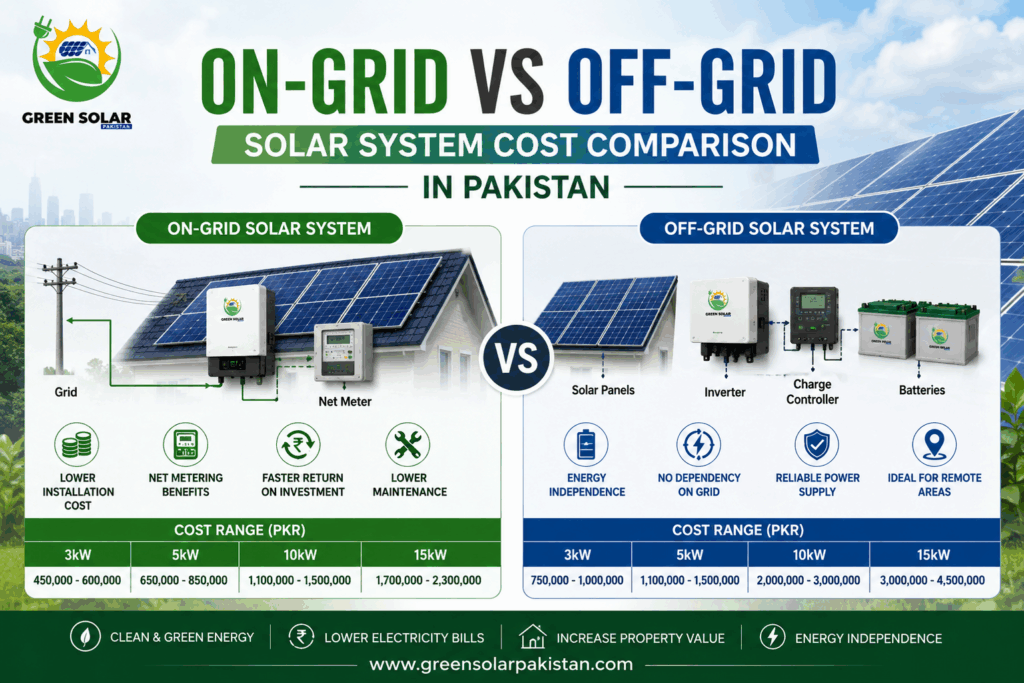
Cost Comparison: On-Grid vs Off-Grid Solar Systems
The biggest difference between these systems is the inclusion of batteries. Batteries significantly increase the overall cost of an off-grid solar installation.
Estimated On-Grid Solar System Costs in Pakistan (2026)
| System Size | Approximate Cost |
|---|---|
| 3kW | PKR 450,000 – 600,000 |
| 5kW | PKR 650,000 – 850,000 |
| 10kW | PKR 1,100,000 – 1,500,000 |
| 15kW | PKR 1,700,000 – 2,300,000 |
Estimated Off-Grid Solar System Costs in Pakistan (2026)
| System Size | Approximate Cost |
|---|---|
| 3kW | PKR 750,000 – 1,000,000 |
| 5kW | PKR 1,100,000 – 1,500,000 |
| 10kW | PKR 2,000,000 – 3,000,000 |
| 15kW | PKR 3,000,000 – 4,500,000 |
The higher costs of off-grid systems are mainly due to battery storage requirements.
Why Are Batteries So Expensive?
Solar batteries store excess electricity generated during the day for use at night or during cloudy weather.
High-quality lithium batteries can account for 30% to 50% of the total project cost. Although they provide backup power, they require replacement after several years depending on usage and maintenance.
This additional expense makes off-grid systems significantly more expensive than on-grid alternatives.
Return on Investment (ROI)
On-Grid Solar System ROI
On-grid systems generally offer a faster return on investment because:
- Lower upfront costs
- Net metering income
- Minimal maintenance expenses
- No battery replacement costs
Typical ROI period:
3 to 5 years
Off-Grid Solar System ROI
Off-grid systems usually take longer to recover costs because:
- Higher initial investment
- Battery replacement expenses
- More maintenance requirements
Typical ROI period:
6 to 10 years
Net Metering Benefits
One major advantage of an on-grid system is net metering.
With net metering, excess electricity generated by your solar panels is exported to the national grid. The utility company credits your account, reducing your electricity bill.
Benefits include:
- Lower monthly electricity bills
- Faster system payback
- Increased savings over time
- Better utilization of solar energy
Off-grid systems do not qualify for net metering because they are not connected to the grid.
Which System Is Better for Homes?
For most urban homeowners in Karachi, Lahore, Islamabad, and other major cities, an on-grid solar system is usually the best option.
Reasons include:
- Lower installation cost
- Net metering availability
- Reliable grid backup
- Better return on investment
However, homeowners facing frequent power outages may consider a hybrid system that combines grid connectivity with battery backup.
Which System Is Better for Businesses?
Commercial facilities often benefit more from on-grid systems because they consume most of their electricity during daylight hours.
Advantages include:
- Significant reduction in electricity bills
- Net metering revenue
- Lower operational costs
- Faster return on investment
Businesses looking for uninterrupted operations can integrate battery backup systems if needed.
Which System Is Better for Remote Areas?
Off-grid systems are ideal for:
- Rural communities
- Agricultural farms
- Remote construction sites
- Areas without electricity infrastructure
Although more expensive, they provide complete energy independence where utility connections are unavailable.
Maintenance Requirements
On-Grid Systems
- Solar panel cleaning
- Inverter inspections
- Electrical safety checks
Maintenance costs are generally low.
Off-Grid Systems
- Battery monitoring
- Battery replacement
- Solar panel cleaning
- Inverter maintenance
Maintenance costs are higher due to battery management.
Environmental Benefits
Both on-grid and off-grid solar systems contribute to a cleaner environment by:
- Reducing carbon emissions
- Lowering fossil fuel consumption
- Supporting sustainable energy production
- Promoting energy independence
Investing in solar energy helps create a greener future for Pakistan.
Why Choose GreenSolar?
At GreenSolar, we provide customized solar solutions for residential, commercial, and industrial clients across Pakistan.
Our services include:
- On-grid solar systems
- Off-grid solar systems
- Hybrid solar systems
- Net metering services
- Solar consultation and design
- Professional installation
- After-sales support
Our experienced team ensures every customer receives the most efficient and cost-effective solar solution for their needs.
Conclusion
Choosing between an on-grid and off-grid solar system depends on your location, energy requirements, and budget. If you have access to a reliable electricity grid and want maximum savings, an on-grid system is typically the best choice. It offers lower installation costs, net metering benefits, and faster returns. If you live in a remote area or require complete energy independence, an off-grid system may be the better option despite its higher upfront cost. Before making a decision, consult with the solar experts at GreenSolar to determine the ideal solution for your home or business.