
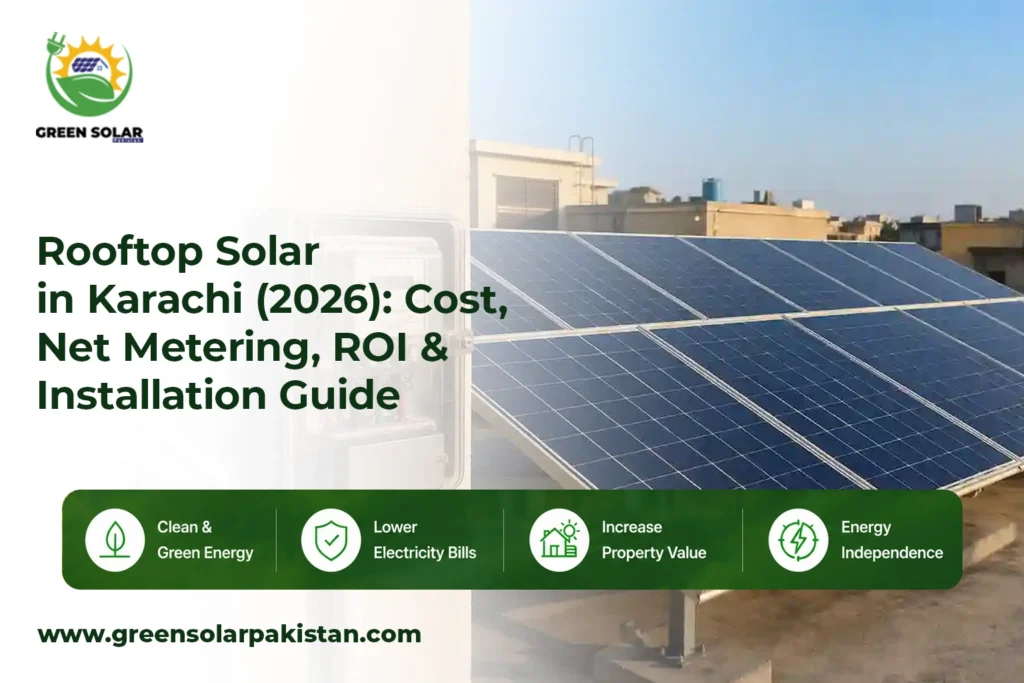
Rooftop solar has become an increasingly practical option for households looking to manage electricity costs and reduce dependence on the conventional power grid. If you are researching solar panels for home Karachi, it is important to understand the complete process, including system size, equipment, installation costs, battery options, net metering, expected savings, and return on investment (ROI). In 2026, Karachi homeowners have more solar choices than ever, but selecting the right system requires careful planning rather than simply choosing the cheapest quotation.
Why Rooftop Solar Is Popular in Karachi
Karachi receives substantial sunlight for much of the year, making rooftop solar suitable for residential electricity generation. A properly designed system can generate electricity during daylight hours and reduce the amount of power a household needs to purchase from the grid.
Rising electricity costs are another major reason homeowners are considering solar. Instead of relying entirely on grid electricity, households can generate part of their own energy through photovoltaic panels installed on the roof.
Solar can be particularly useful for homes with significant daytime consumption from appliances such as air conditioners, refrigerators, water pumps, computers, and other electrical equipment.
How a Rooftop Solar System Works
A residential solar system typically consists of solar panels, an inverter, mounting structures, electrical protection equipment, cables, and monitoring equipment.
Solar panels convert sunlight into direct-current electricity. The inverter then converts that electricity into alternating current that household appliances can use.
Depending on the system design, excess electricity can either be exported to the grid under the applicable regulatory arrangement or stored in batteries for later use.
A grid-connected system without batteries is generally designed around reducing daytime grid consumption and exporting eligible surplus electricity. A hybrid system can additionally use batteries to provide backup and shift solar energy into evening hours.
How Much Solar Does a Karachi Home Need?
There is no universal system size for every home. The correct capacity depends on electricity consumption, available roof space, daytime usage, budget, and whether batteries are required.
A small household may need a relatively modest system, while a larger home with multiple air conditioners and high electricity consumption may require considerably more capacity.
The best way to determine system size is to examine several months of electricity bills and identify your average monthly units. An installer can then estimate the appropriate solar capacity based on your consumption pattern and available roof area.
For example, a home that consumes significantly more electricity during summer may require a different design from a home with consistent year-round consumption.
Solar Panel Cost in Karachi in 2026
Solar prices can change frequently because the overall cost depends on panel technology, inverter brand, system capacity, exchange rates, installation requirements, and market conditions.
A basic residential solar quotation may include:
- Solar panels
- Inverter
- Mounting structure
- DC and AC protection
- Wiring and connectors
- Installation labor
- Monitoring equipment
- Batteries, if required
- Applicable taxes and other charges
As a general 2026 market guide, an installed on-grid solar system without battery storage may cost approximately PKR 360,000–500,000 for 3 kW, PKR 650,000–850,000 for 5 kW, PKR 1.1–1.4 million for 10 kW, and PKR 1.45–1.8 million for 15 kW. These are indicative market ranges rather than fixed Karachi tariffs, and actual quotations can vary based on panel and inverter brands, mounting structure, electrical work, installation complexity and applicable grid-interconnection costs. Recent market reports also show that prices can move significantly within a short period, so homeowners should obtain a current quotation before making a purchase.
Instead of judging quotations only by the total price, homeowners should compare the equipment specifications and warranty terms.
Two systems with the same advertised capacity can have very different components and long-term value.
Read More: Solar Panel Price in Karachi: System Cost Analysis and ROI Calculation
What Affects Solar Installation Cost?
Several factors influence the final cost of a rooftop solar installation in Karachi.
System Capacity
A larger system generally requires more panels, a larger inverter, more mounting material, and additional electrical components.
Solar Panel Technology
Different panels offer different efficiency levels, warranties, physical dimensions, and performance characteristics. Higher-efficiency panels can be useful when roof space is limited.
Inverter Selection
The inverter is one of the most important components of a solar installation. It determines how effectively solar electricity is converted for household use and may provide monitoring and other features.
Battery Storage
Adding batteries can significantly increase the initial investment. However, batteries can provide backup power and allow households to use stored solar energy after sunset.
Roof Structure and Installation
The condition, shape, accessibility, and orientation of the roof can affect installation requirements and labor costs.
On-Grid vs Hybrid Solar in Karachi
Homeowners generally need to decide whether they want an on-grid or hybrid system.
On-Grid Solar
An on-grid system works alongside the electricity grid. During daylight hours, solar generation can reduce the home’s grid electricity consumption.
Surplus electricity may be exported under the applicable rules and billing arrangement.
The major advantage of an on-grid system is usually its lower upfront cost compared with a system that includes substantial battery storage.
However, standard grid-tied systems typically do not provide the same backup functionality during a grid outage unless the system has suitable backup equipment.
Hybrid Solar
A hybrid system combines solar generation, grid electricity, and battery storage.
During the day, solar energy can power household appliances and charge the batteries. Stored energy can then be used when solar production falls or during an outage, depending on the system configuration.
Hybrid systems are particularly attractive to households that want both electricity-bill savings and backup power.
Net Metering in Pakistan: What Karachi Homeowners Should Know
Net metering has historically been an important consideration for homeowners installing rooftop solar in Pakistan. However, regulations, tariff structures, application procedures, and billing arrangements can change.
Therefore, anyone planning a new solar installation in Karachi in 2026 should verify the current rules and requirements with the relevant authorities and electricity distribution company before signing an installation contract.
Do not rely solely on an old quotation or information from social media because the regulatory framework can change over time.
Your installer should explain how the current grid-interconnection process applies to your property and whether your proposed system meets the applicable technical requirements.
Solar ROI: How Quickly Can You Recover Your Investment?
Return on investment depends on several variables rather than one fixed number.
The most important factors include the following:
- Total system cost
- System size
- Electricity consumption
- Solar generation
- Electricity tariff
- Daytime electricity usage
- Export compensation or applicable billing rules
- Battery cost
- Maintenance expenses
- System performance over time
A household that consumes a large amount of electricity during daylight hours may achieve better savings from a solar system because more generated electricity can be used directly.
A home with low daytime consumption may benefit from a different system design.
For a simple ROI calculation, homeowners can compare the initial investment with estimated annual electricity savings.
Estimated payback period = Total solar investment ÷ Estimated annual savings
This is only a simplified calculation. A professional financial assessment should also consider changes in electricity prices, system degradation, maintenance, financing costs, battery replacement, and regulatory changes.
How Much Electricity Can Solar Generate?
Solar generation depends on system capacity, sunlight, panel orientation, shading, temperature, equipment efficiency, and maintenance.
Karachi’s climate provides strong solar potential, but actual production varies throughout the year.
A reputable installer should provide an estimated generation report based on the proposed system and site conditions instead of promising a fixed number of units every month.
Homeowners should also ask whether the estimate accounts for system losses and real-world operating conditions.
Choosing the Right Solar Panels
Not all solar panels are identical.
When comparing panels, consider efficiency, product warranty, performance warranty, degradation rate, manufacturer reputation, dimensions, and compatibility with your roof.
Higher efficiency can be especially valuable for Karachi homes where roof space is limited.
It is also important to verify the authenticity and warranty documentation of the products being supplied.
Choosing a Solar Inverter
The inverter deserves just as much attention as the panels.
Depending on your requirements, you may consider a string inverter, hybrid inverter, or another suitable configuration.
When selecting an inverter, consider its capacity, efficiency, monitoring features, warranty, service availability, and compatibility with batteries if you plan to add storage later.
A cheaper inverter may not necessarily provide the best long-term value if after-sales support is poor.
Battery Storage: Is It Worth It?
Battery storage is useful when backup power is important or when you want to use more solar-generated electricity after sunset.
However, batteries increase the upfront cost of a solar installation and have a finite service life.
Before buying batteries, calculate how much electricity your home actually needs during evening and outage periods.
If your main goal is reducing daytime grid consumption, an on-grid configuration may be sufficient. If uninterrupted power is a major priority, a hybrid system with appropriate battery capacity may be more suitable.
Solar Installation Process in Karachi
A professional installation normally begins with a site assessment.
The installer evaluates the roof, electricity consumption, shading, available space, and electrical infrastructure.
The next stage is system design and equipment selection. Once the design is approved, mounting structures and panels are installed, followed by inverter and electrical connections.
The system should then be tested and commissioned properly.
For grid-connected installations, any required interconnection documentation and approvals should be handled according to the current applicable procedure.
Maintenance Requirements
Solar panels generally require relatively low maintenance, but they are not completely maintenance-free.
Dust, pollution, bird droppings, and other debris can accumulate on panels and reduce their performance.
Karachi’s dusty environment makes periodic inspection and cleaning particularly useful.
Homeowners should also monitor the inverter and system monitoring platform for unusual production changes.
If electricity generation suddenly drops without an obvious reason, the system should be inspected by a qualified technician.
Common Mistakes to Avoid
One of the biggest mistakes is choosing a solar company based only on the lowest quotation.
Homeowners should compare equipment quality, warranties, installation standards, after-sales support, and estimated generation.
Another mistake is purchasing a system that is too large or too small for actual electricity consumption.
It is also risky to assume that a solar system automatically eliminates electricity bills. Grid charges, taxes, fixed charges, consumption patterns, and applicable billing rules can affect the final bill.
Finally, avoid making financial decisions based on guaranteed savings or payback claims without reviewing the assumptions behind them.
Is Rooftop Solar Worth It for Karachi Homes in 2026?
For many households, rooftop solar can be a worthwhile long-term investment, particularly when electricity consumption is high and the system is properly designed.
However, the best system depends on the individual property.
Before purchasing, review your electricity bills, determine your energy requirements, compare on-grid and hybrid options, check the latest applicable regulations, and obtain multiple detailed quotations.
The objective should not simply be to install the largest possible system. Instead, choose a system that balances generation, consumption, backup requirements, roof space, upfront cost, and long-term savings.
Final Thoughts
Rooftop solar can help Karachi homeowners take greater control of their electricity consumption and potentially reduce long-term energy expenses. With abundant sunlight and increasingly accessible solar technology, residential solar remains an important option for households evaluating their energy strategy in 2026.
Whether you choose an on-grid or hybrid system, careful planning is essential. Compare the complete equipment package, verify warranties, understand current grid-interconnection and billing rules, and calculate ROI using realistic assumptions.
A well-designed solar installation should be based on your home’s actual electricity consumption rather than a generic package. By taking this approach, homeowners can make a more informed decision and select a solar solution that fits their budget and energy needs.
FAQs
How many solar panels does a home in Karachi need?
The number depends on household electricity consumption, panel capacity, available roof space, shading, and the desired system size. Reviewing your electricity bills is the best starting point.
Is solar worth installing in Karachi in 2026?
Solar can be worthwhile for many Karachi homes, particularly those with high electricity consumption. However, the financial return depends on system cost, electricity usage, generation, tariffs, and current regulations.
What is better for a Karachi home: on-grid or hybrid solar?
On-grid solar can be suitable when your primary goal is reducing grid electricity consumption. Hybrid solar may be preferable when you also want battery backup during outages.
How much does a home solar system cost in Karachi?
There is no single fixed price. Cost depends on system capacity, panel and inverter brands, mounting requirements, battery storage, installation, taxes, and other components. Get a detailed quotation based on your property.
Do solar panels work during load shedding?
Solar panels generate electricity when sunlight is available, but whether your home continues receiving power during a grid outage depends on the system configuration. A standard grid-tied system may shut down during an outage, while an appropriately designed hybrid or backup system can provide power.
How long do solar panels last?
Modern solar panels are designed for long-term operation, with manufacturers typically providing long performance warranties. Actual lifespan and output depend on product quality, environmental conditions, installation, and maintenance.
How often should solar panels be cleaned in Karachi?
Cleaning frequency depends on dust, pollution, bird activity, and the site’s environment. Because Karachi can experience dusty conditions, homeowners should inspect panels regularly and clean them when significant buildup is visible.
Can I install solar panels on any roof?
Most suitable roofs can accommodate solar, but the installer should assess structural condition, available space, orientation, shading, waterproofing, and mounting requirements before installation.
What should I check before buying solar panels for my home?
Check panel efficiency, warranties, manufacturer reputation, inverter quality, installation standards, estimated energy production, after-sales service, and the total installed cost.
Does solar completely eliminate an electricity bill?
Not necessarily. Your final bill depends on electricity consumption, solar generation, grid usage, applicable tariffs, fixed charges, taxes, and the current billing or export arrangement. Solar can reduce electricity costs without necessarily making every bill zero.