
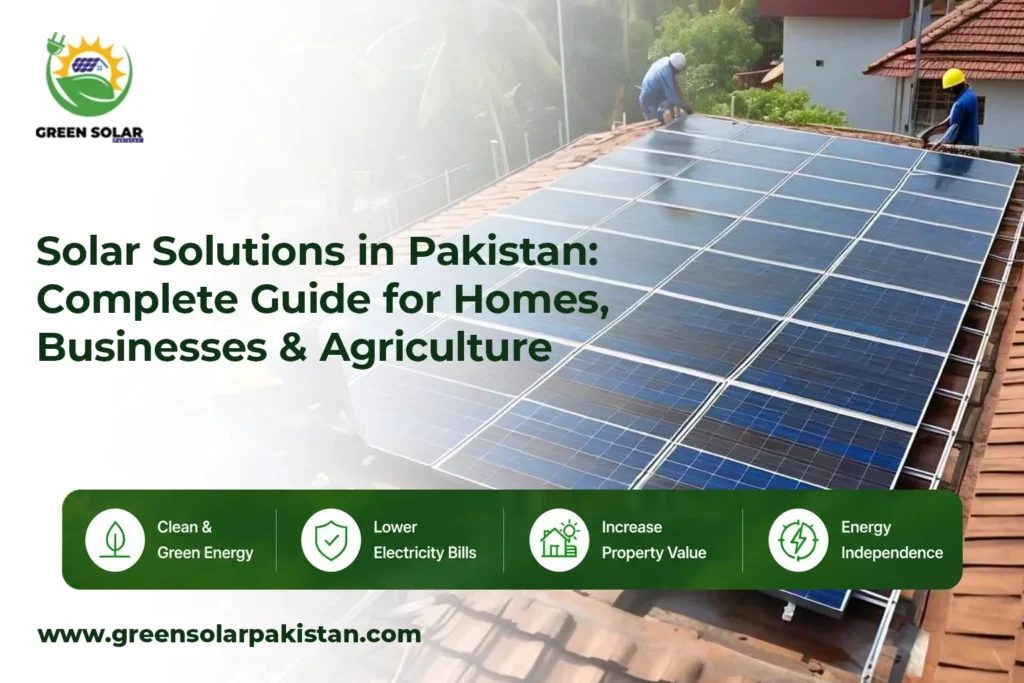
If your electricity bill is eating half your monthly income and load-shedding still cuts your evenings short, you already know why solar solutions in Pakistan have become a major energy consideration for households, businesses, and farmers across Pakistan. Whether you run a home in Lahore, a stitching unit in Faisalabad, or a tube well in rural Sindh, a correctly sized solar system can significantly reduce electricity costs, with the actual savings depending on system size, daytime consumption, tariffs, and whether excess power is exported or stored.
This guide walks through real 2026 costs, the new net billing rules, and which solar energy solution in Pakistan actually fits your roof, your business, or your farm—no sales pitch, just the numbers and decisions that matter.
Why Pakistan Is Turning to Solar Energy
Pakistan’s shift to solar hasn’t been driven by a marketing campaign—it’s been driven by math. Grid electricity has become unpredictable in both price and availability, and rooftop solar has quietly become the country’s fastest-growing power source. By 2025, solar was already estimated to account for more than a quarter of Pakistan’s total electricity production, a jump that surprised even energy regulators, since a large share of it sits “behind the meter” on homes, shops, and farms rather than in official grid statistics. Cumulative solar panel imports from China have passed 51 GW, and panel prices have fallen by more than half since 2023 as global supply increased—which is exactly why solar solutions in Pakistan now cost a fraction of what they did just three years ago.
Rising Electricity Bills and Load Shedding
For most households and small businesses, the decision to go solar isn’t really a decision — it’s a response. Tariffs climb every few months, fuel adjustment charges show up without warning, and feeder-level load shedding still hits industrial zones and rural areas hardest. Installers across Lahore, Karachi, and Islamabad report the same pattern year after year: for households with consistently high electricity consumption, solar can offer a stronger financial case, but the payback period depends on system cost, electricity usage, tariffs, solar generation, financing, and the treatment of exported electricity.
Government Policy Shift: Net Metering to Net Billing in 2026
This is the part most guides skip, and it’s the one that actually changes your numbers. On February 9, 2026, NEPRA replaced the decade-old net metering framework with a new “net billing” system under the Prosumer Regulations 2026. Under the old rules, every unit you exported to the grid was credited at the same rate as a unit you imported. Under the new rules, new solar consumers sell surplus electricity back to their DISCO at a much lower rate — around Rs. 8-11 per unit — while still paying full retail rates, often Rs. 55-65 per unit, for anything they import. Consumers who signed net metering agreements before February 9, 2026 are grandfathered in at their original rates until their contracts expire.
The practical takeaway: solar is still worth it, but the design has to change. Oversized systems built to export as much as possible no longer make financial sense. For many new installations, sizing the system around daytime consumption and considering battery storage can improve self-consumption and reduce reliance on lower-value exports.
Solar Solutions for Homes in Pakistan
Home solar is still the single biggest segment of the market, and residential rooftops are expected to keep accounting for the majority of new solar capacity added each year.
Types of Residential Solar Panel Systems in Pakistan
On-Grid Solar Systems
An on-grid system stays connected to WAPDA or your local DISCO and uses the grid as backup when your panels aren’t producing enough. It’s the cheapest option upfront since it skips batteries entirely, but under the new net billing rules, any surplus you send back earns far less than it used to—so on-grid setups make the most sense for households that can shift most of their heavy usage (AC, washing machine, water pump) into daylight hours.
Off-Grid Solar Systems
A fully off-grid solar Pakistan setup relies entirely on panels and batteries with no grid connection at all. This is the right fit for remote areas, hill stations, far-flung agricultural land, or regions with chronic outages where grid access is unreliable or simply unavailable. It costs more per kilowatt because batteries have to cover 100% of your night-time needs, not just a portion of them.
Hybrid Solar Systems
Hybrid systems combine solar panels, a battery, and a grid connection through a smart inverter that automatically decides where your power comes from. Given the 2026 shift toward self-consumption, hybrid has quickly become the most recommended configuration for solar solutions Pakistan homeowners are installing this year. You use solar by day, store the extra in a lithium battery, draw from that battery at night, and only touch the grid as a last resort.
Average Cost of Home Solar Solutions in Pakistan
As of mid-2026, installed solar panel systems in Pakistan generally run somewhere between Rs. 25 and Rs. 45 per watt, depending on panel brand, inverter quality, and city. In practical terms, a 5 kW on-grid system for a mid-sized home typically lands between Rs. 750,000 and Rs. 1.5 million installed, while adding lithium battery storage for a hybrid setup can push a similar system to Rs. 1.3-2.5 million. These are indicative ranges; always get an itemized quote listing exact panel models, inverter brand, and battery capacity, since two quotes for “5 kW” can differ by hundreds of thousands of rupees depending on what’s actually inside the box.
How Many Solar Panels Do You Need in Pakistan?
The number of solar panels required depends on the system size and the wattage of each panel. For example, modern panels commonly range around 500–600 watts, so the same system capacity can require different numbers of panels.
| Solar System Size | Approx. Panels at 550W |
|---|---|
| 3 kW | 6 |
| 5 kW | 10 |
| 8 kW | 15 |
| 10 kW | 19 |
Actual panel count depends on the selected panel wattage, system design, available roof space, and electricity requirements.
Solar Solutions for Businesses in Pakistan
Commercial and industrial consumers aren’t a side note in Pakistan’s solar story; they held roughly half of the country’s installed solar capacity by 2025, and that share keeps growing as energy costs squeeze operating margins.
Commercial Solar Systems for Shops, Offices & Retail
For shops, clinics, schools, and small offices, commercial solar solutions Pakistan providers usually recommend systems sized to daytime operating hours, since that’s when most retail and office loads (lighting, AC, computers and refrigeration) actually run. This alignment between solar production and business hours is what makes commercial solar one of the fastest-payback categories in the entire market you’re consuming almost everything you generate, with little reliance on the now-less-generous export rate.
Industrial Solar Power Solutions for Factories
Textile mills, cold storage facilities, and manufacturing plants have some of the highest electricity bills in the country, which is exactly why industrial solar power Pakistan installations tend to deliver the strongest returns. A 100 kW+ rooftop or ground-mounted system can offset a meaningful share of a factory’s daytime load, reducing dependence on captive gas generation or expensive peak-hour grid tariffs. In our experience working alongside installers on commercial sites, factories that run two or three shifts get the best results by combining solar with a smaller battery buffer just to smooth out cloudy-day dips, rather than trying to go fully off-grid.
Solar Solutions for Agriculture in Pakistan
Agriculture is one of the most underrated corners of Pakistan’s solar market, even though the savings here are often the most dramatic.
Solar Tube Wells and Irrigation Systems
Diesel-powered tube wells have long been one of the highest recurring costs for Pakistani farmers, and solar tube well systems in Pakistan are steadily replacing them. Industry estimates suggest roughly 650,000 of Pakistan’s 1.35 million tube wells now run on solar, though many still use diesel as backup for night-time irrigation or during extended cloudy spells, since battery storage remains too costly for much of the farming sector.
Benefits for Farmers: Diesel Savings and Reliability
For farmers, agricultural solar solutions in Pakistan solve two problems at once: unpredictable diesel prices and unreliable grid access in rural feeders. A solar tube well eliminates the daily fuel run and the maintenance that comes with a diesel engine, while running during the exact hours crops need water most: daylight. The upfront cost is higher than a diesel pump, but most farmers recover that investment within two to four irrigation seasons, depending on tube well depth and farm size.
How to Choose the Right Solar Solutions Provider in Pakistan
With hundreds of installers now competing across the country, picking the right one matters as much as picking the right panel.
Key Factors to Consider
- AEDB and NEPRA certification — confirm the installer is authorized to design and submit net metering or net billing applications on your behalf.
- Equipment warranty — look for panel warranties of 12+ years product and 25 years performance, plus at least 5 years on the inverter.
- Battery specification transparency — ask for the exact battery chemistry (lithium iron phosphate is the current standard) and usable capacity, not just headline kWh.
- After-sales service — a solar system is a 20-25 year investment; make sure the installer has a real service team, not just a sales office.
- Itemized, written quotes — never accept a single lump-sum number without a breakdown of panels, inverter, battery, mounting, and labor.
Cost, ROI, and Payback Period of Solar Solutions in Pakistan
Payback periods have shifted in 2026, and it’s worth being honest about that rather than repeating outdated numbers. Under the old net metering rules, a well-sized home system could pay for itself in three to four years. Under the new net billing framework, with lower export rates but rising retail tariffs, most self-consumption-focused systems still pay back within four to six years — still a strong return for a system that keeps producing for two decades or more. The single biggest lever homeowners and businesses have now is self-consumption: every unit you use directly saves you the full retail rate, while every unit you export earns only a fraction of that. That’s why battery storage, once considered optional, is quickly becoming a standard part of solar solutions Pakistan installers are recommending in 2026.
The Future of Solar Power in Pakistan
The direction of travel is clear even with the policy turbulence. Installed solar capacity is forecast to climb from roughly 8 GW in 2026 to over 18 GW by 2031, and utility-scale projects are starting to catch up with the rooftop boom, including a planned 500 MW floating solar project on Keenjhar Lake in Sindh and a 100 MW push combining utility-scale and rooftop solar across Gilgit-Baltistan. For everyday consumers, that growth means continued price competition on equipment, even as the compensation for exported power settles into its new, lower normal. If you’re weighing your options today, a well-researched solar solutions in Pakistan provider can walk you through current DISCO timelines, realistic system sizing, and financing options before you commit.
Frequently Asked Questions (FAQs)
Q1: What is the average cost of solar solutions in Pakistan for a home?
A typical 5 kW on-grid home system costs roughly Rs. 750,000 to Rs. 1.5 million installed in 2026, while a hybrid system with lithium battery storage can range from Rs. 1.3 million to Rs. 2.5 million, depending on brand and battery size.
Q2. Is net metering still available in Pakistan in 2026?
Net metering was replaced by a new “net billing” system on February 9, 2026. Consumers with agreements signed before that date remain on their original terms until expiry; new applicants fall under net billing, with a lower buyback rate for exported electricity.
Q3. How many solar panels do I need for a 3-bedroom house in Pakistan?
Most 3-bedroom homes with moderate AC use need a system between 5 kW and 8 kW, which usually works out to around 9-14 panels, depending on panel wattage and your actual monthly unit consumption.
Q4. Which is better: on-grid, off-grid, or hybrid solar system?
For most urban homes with grid access, hybrid is now the most practical choice since it maximizes self-consumption under the new billing rules. Off-grid suits remote areas with no reliable grid connection, while on-grid remains the lowest-cost option for consumers who can shift usage into daylight hours.
Q5. How much can businesses save with commercial solar solutions in Pakistan?
Businesses that align solar production with operating hours often offset 50-80% of their daytime electricity costs, with industrial users running multiple shifts typically seeing the fastest payback due to their high baseline consumption.
Q6. Are solar tube wells worth it for farmers in Pakistan?
Yes, solar tube wells eliminate daily diesel costs and typically pay for themselves within two to four irrigation seasons, though many farmers keep a small diesel or grid backup for night-time or low-sunlight periods.