
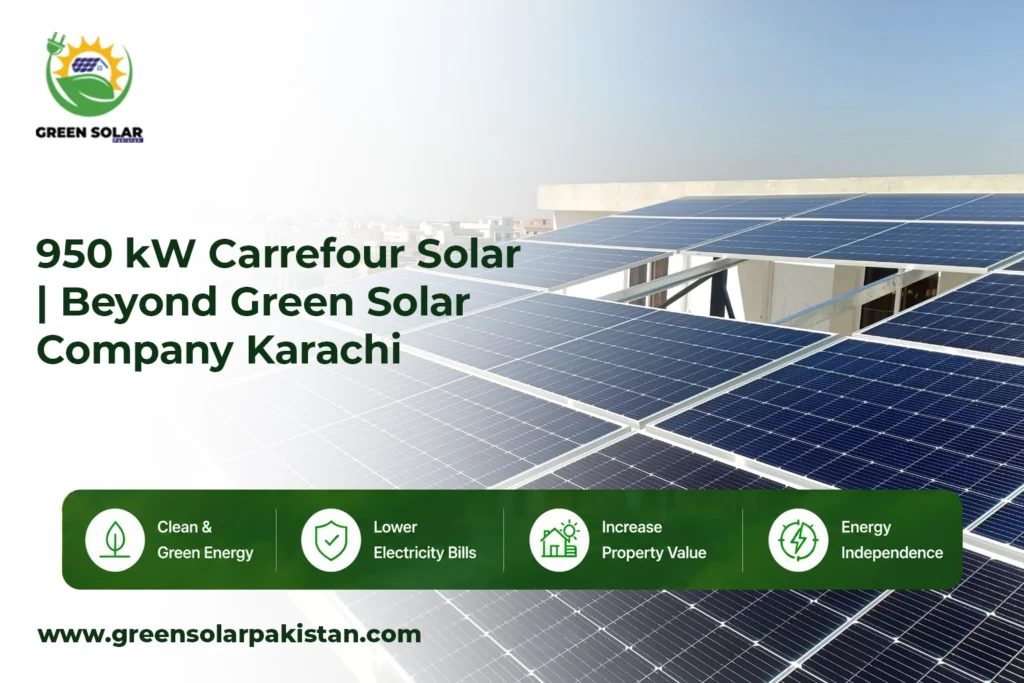
In 2024, Pakistan imported 17 GW of solar panels, double what it brought in the year before, according to Ember’s Global Electricity Review 2025. Plenty of those panels ended up on commercial roofs, and a 950 kW solar system in Pakistan shows how far the shift has gone. It is big enough to run a serious operation, yet small enough to sit on the roof of a single warehouse or factory.
The timing is no accident. The average export price per watt of Chinese panels shipped to Pakistan fell 54 per cent between 2022 and 2024, according to Ember data reported by Business Standard. Meanwhile, grid tariffs keep climbing and supply is still unreliable, so retailers, warehouse owners and factory managers are looking up at their roofs and doing the sums.
If that sounds like you, here is what a green solar company Karachi would walk you through: what 950 kW really means, how much power it makes, how it gets built, what it can save and what to check before you commit. But first, a question worth sitting with. What does it take to power a large commercial site from its own roof?
Why Commercial Solar Installation in Pakistan Is Growing So Fast
The shift shows up clearly in Ember’s data. Solar supplied about 25% of utility electricity in the first four months of 2025, and cumulative panel imports have since passed 50 GW.
For a business, though, three plain facts matter more than the headline numbers. First, tariffs and power cuts: an hour of downtime on a production line costs far more than the electricity it would have used, and tariffs only seem to move in one direction. Second, daytime demand. A shop, warehouse or factory works hardest when the sun is strongest, so the power gets used as it is made. Third, module prices have fallen far enough that a system that once looked like a luxury now looks like a sensible line item.
Which brings us to what a system of this size actually looks like.
What Is a 950 kW Solar System in Pakistan?
950 kW is the DC capacity: the combined rating of every panel on the roof, not what the inverters deliver at any one moment. How many panels that takes depends on how powerful each one is.
- About 1,460 panels at 650 W
- About 1,640 panels at 580 W
- About 1,730 panels at 550 W
At 580 W, the panels alone cover roughly 4,200 m². Spacing, walkways and maintenance access push the real footprint higher, and the exact figure depends on the module and the roof.
Daily and yearly output in Karachi
The Global Solar Atlas gives Karachi a specific yield of about 1,678 kWh per kWp a year, or roughly 4.6 kWh per kWp a day. Multiply by 950 and the theoretical ceiling is about 4,370 kWh a day. No real system reaches it. Heat, dust, cabling and inverter losses all take a share, so a fairer expectation is 3,500–3,900 kWh a day, or about 1.3–1.4 million kWh a year. That is an estimate, not a guarantee. Measured data from a running site is what settles it.
What goes into the system
Beyond the panels you need inverters, mounting structures, protection equipment, metering and a monitoring system that shows output day by day. There are plenty of ways to specify each one, so ask your installer to explain what they are proposing and why.
How Large Scale Solar Power Projects in Pakistan Get Built
A commercial solar installation in Pakistan at this size tends to follow the same sequence.
- Site survey and structural assessment. Someone checks the roof strength, shading, available area and how the building uses power through the day. Skipping this step is where many projects run into trouble.
- Design, approvals and grid connection. The design covers layout, electrical protection and the utility interconnection. NEPRA’s prosumer rules apply to systems up to 1 MW, so a 950 kW system falls inside that category.
- Installation, testing and commissioning. Structures go up first, then panels, cabling and inverters. Everything is tested against safety standards before switch-on, and performance is verified once the system is running.
Keeping output up in a coastal city
Karachi is hard on panels. Salt, dust and bird droppings all cut output, sometimes by more than owners expect. Regular cleaning and monitoring catch the dip early. Birds deserve their own mention, and there is a separate guide on bird-proofing a Solar System in Pakistan if they are a problem on your site.
The Business Case for an Industrial Solar System in Pakistan
An industrial solar system in Pakistan pays off in several ways, and not all of them appear on the electricity bill. It is one reason solar energy solutions for businesses in Pakistan now get as much attention from finance teams as from sustainability teams.
Lower, steadier power costs. A system producing 1.3–1.4 million kWh a year saves roughly Rs 13–14 million for every Rs 10 per kWh of tariff you avoid. Swap in your own tariff and you have a first-pass number.
Less exposure to the grid. Every unit you generate is a unit you do not buy, which cushions you against tariff increases. Staying online during an outage is a different matter. A standard grid-tied system shuts down with the grid, so backup needs storage or a hybrid design.
A better story to tell. Lower emissions feed straight into ESG reporting, and customers and partners notice when a business runs on its own clean power.
Low running costs, long life. Solar has few moving parts, so upkeep is mostly cleaning and inspection. Ask for the module warranty and annual degradation figures in writing, because they decide how much power you still get in year 15.
Before You Sign: What Businesses Should Check
Any of the solar energy solutions for businesses in Pakistan can look good on paper. These checks tell you whether one will work on your site.
Start with your daytime load
The more of the output you use yourself, the better the return. An energy audit shows how much power your site draws during daylight hours and how much of a 950 kW system’s output it can absorb.
Net billing rules
This is the part that changes the maths most. NEPRA’s rules, notified on 9 February 2026, replaced net metering with net billing. Surplus power you export is now bought back at a rate tied to the national average energy purchase price, not at the retail tariff you pay. Reported figures sit around Rs 10–11 per unit, against roughly Rs 26 under the old system, though numbers differ from one report to the next. Check the current rate on NEPRA’s website before you finalise any financial model. The practical takeaway is simple: size the system for what you will use yourself, not for what you hope to sell back.
Payback, financing and warranties
Ask every installer for a payback estimate built on your own bills and load profile, not a generic headline figure. Compare financing options carefully, and get product, performance and workmanship warranties in writing.
Choosing an installer
Look for experience at a similar scale, not just a long list of small rooftop jobs, and for after-sales support that will still pick up the phone in year five. Smaller needs follow the same logic at a lower scale. For a house or apartment, start with the home solar system Karachi page.
Frequently Asked Questions
How much electricity can a 950 kW solar system generate per day?
A realistic figure for Karachi is 3,500–3,900 kWh a day. The theoretical ceiling is about 4,370 kWh, but heat, dust, wiring and inverter losses bring it down. Output also shifts with the seasons and with how well the panels are cleaned and maintained, so treat any daily number as an estimate.
How many solar panels are required for a 950 kW solar system?
Roughly 1,460 to 1,730, depending on the module wattage: about 1,460 panels at 650 W, 1,640 at 580 W and 1,730 at 550 W. At 580 W the panels alone cover about 4,200 m², so plan for extra roof or carport space for spacing and access.
What are the benefits of a large-scale commercial solar installation?
The main ones are lower and steadier electricity costs, less reliance on the grid, a smaller carbon footprint for ESG reporting and low running costs over a long asset life. The business case section above covers each of these in more detail.
How much can businesses save with a commercial solar system in Pakistan?
Savings equal the kWh you use yourself multiplied by the tariff you avoid. At 1.3–1.4 million kWh a year, every Rs 10 per kWh of avoided tariff is worth roughly Rs 13–14 million. Under net billing, exports earn far less than retail rates, so your real savings depend on your daytime load.
Is a 950 kW solar system suitable for shopping malls and industrial buildings?
Yes, wherever there is strong daytime demand and enough roof or carport space. An industrial solar system in Pakistan that runs through the working day will use most of what it generates. Before committing, get a structural check on the roof and an energy audit of your load profile.
Final Thoughts
Pakistan’s solar rush has reached commercial roofs for good reasons: expensive grid power, patchy supply and cheaper panels. A 950 kW system needs roughly 1,460–1,730 panels, depending on wattage, and should produce around 3,500–3,900 kWh a day in Karachi. The delivery path runs from site survey to commissioning, and that holds for any commercial solar installation in Pakistan, whatever its size.
What to carry away:
- Karachi’s solar yield is strong, but plan around a realistic estimate rather than the theoretical ceiling.
- Under net billing, savings come from the power you use yourself.
- Salt, dust and birds are real, so maintenance is part of the deal.
- At this scale, installer experience matters more than the lowest quote.
Sites with heavy daytime demand and a sound roof are the best fit. Before you decide anything, get an energy audit. It will tell you more about your own numbers than any article can.
A reliable company like Green Solar Pakistan starts by assessing your electricity bills and rooftop space before recommending a suitable solar solution, rather than pushing a sales pitch.